Subscribe to the ECORD News

Category: News

All News

ECORD at EGU 2026

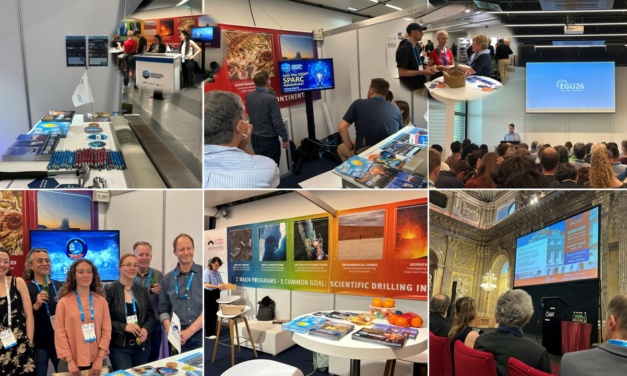
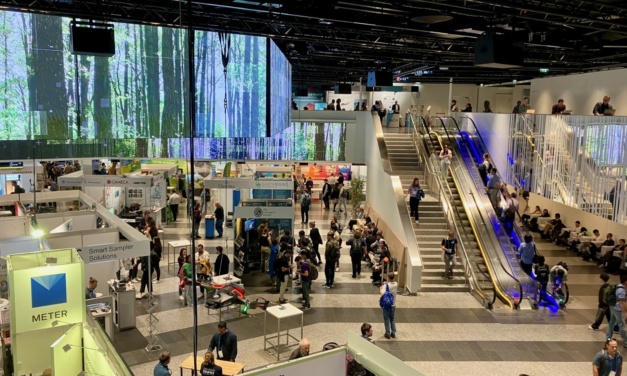
The EGU General Assembly 2026 will take place in Vienna from 3 to 8 May, and ECORD will be actively present throughout the week.
You will find us at the joint Scientific Drilling booth (50/51) in the exhibition area, shared with ICDP an IODP3. This will be an opportunity to engage with the scientific drilling community, learn more about ECORD activities, and discuss current and future developments in ocean drilling research.
Booth opening hours:Monday–Thursday: 10:00–18:00Friday: 10:00–13:00
On Monday evening, ECORD will participate in the joint ICDP–IODP³–ECORD Town Hall at the Austrian Academy of Sciences. The event will provide a forum for exchange on ongoing initiatives and future perspectives in scientific drilling. Doors open at 18:30, talks begin at 19:00.

Welcome (Bernhard Plunger, Austrian Academy of Sciences)
Austria’s participation in ICDP (Christian Köberl, University of Vienna)
Austria’s participation in IODP and IODP3 (Michi Strasser, University of Innsbruck)
News and Views in IODP3 (Nadine Hallmann, Director of the EMA and of the IODP3 Managing Agency)
News and Views in ICDP (Marco Bohnhoff, Executive Director of ICDP)

Featured session:ITS5.1/CL0.6 – Achievements and Perspectives in Scientific Ocean and Continental Drillinghttps://www.egu26.eu/session/57656
ECORD will also contribute to a series of informal pop-up events at the booth:
SPARC Adventure – a conversation on the IODP3SPARCs expeditionTuesday: 13:00Wednesday: 17:00Thursday: 13:00
Documentary screening: “The Story of Stress”Tuesday: 17:30Thursday: 17:30

Extensive freshened water beneath the ocean floor confirmed for the first time

International team provides first detailed evidence of long-suspected hidden fresh water aquifers
For the first time, a science team directly documented and extensively sampled a freshened water system beneath the ocean floor. This major discovery comes from the initial analyses of sediment cores recovered during an international scientific expedition led by Co-Chief Scientists Professor Brandon Dugan (Colorado School of Mines, Golden, USA) and Professor Rebecca Robinson (Graduate School of Oceanography, University of Rhode Island, USA). The cores, retrieved from deep below the sea floor, are now being opened, analysed and sampled by the science team, during almost a month of intensive collaborative work at the University of Bremen. During January and February 2026 the expedition’s scientists are working side by side to uncover new insights into the formation, evolution, and significance of this newly documented subseafloor freshwater system.
The goal of this expedition went far beyond collecting sediment cores. Scientists also set out to sample the water stored within the sediments, including from sandy layers that act as aquifers and from clay layers that usually keep the water in place beneath the seafloor, known as aquitards. Although roughly 70 per cent of Earth’s surface is covered by water, significant volumes of water also move and are stored below ground. Many coastal communities depend on land-based aquifers for their freshwater supply. What fewer people realize is that, in many parts of the world these aquifers continue offshore, containing zones of freshened, slightly briny water beneath the ocean floor. Scientists have known these offshore systems existed since 1976, but they have remained virtually unexplored until now. During this expedition, the science team successfully documented and sampled freshened water within a zone nearly 200 metres thick below the seafloor.
Brandon Dugan: “We were excited to see that freshened water exists in multiple kinds of sediments – both marine and terrestrial. Freshened water in such different materials will help us understand the conditions that emplaced the water.” Further analyses that are conducted by the science team will help to find out where and especially when the water was placed here.
Rebecca Robinson: “The cores contain sediment with a wide range of composition and ages. It was surprising to see sediment, not rocks, throughout the section. The sediment has not yet transformed into rock – I did not expect to see that and it will be an interesting component of our future work.” In order to understand when and how the sediments were deposited, the science team is developing age models.
Shedding light on similar water aquifers around the world
The approach used during IODP³-NSF Expedition 501 will not only deepen understanding of offshore freshened groundwater systems off the coast of New England, but will also shed light on similar hidden water aquifers around the world. Because many coastal regions rely on groundwater for their freshwater supply, the expedition’s initial findings are highly relevant to society. The research will also reveal how nutrients such as nitrogen cycle through continental shelf sediments and how these processes influence the abundance and diversity of microbes living in these environments. These goals align closely with the 2050 Science Framework for Ocean Research Drilling – one of the foundations of the IODP³ scientific programme. Ultimately, the expedition’s research will help to decipher how sediments and fluids cycle through the Earth system and improve our knowledge about sea level changes and freshwater flow beneath the seabed along our coastal shelves. “The researchers will continue to work on and with the samples to decipher more – for example, to date the groundwater more accurately which is critical to advancing our knowledge,” adds Rebecca Robinson.
The expedition is a joint collaboration between the International Ocean Drilling Programme (IODP³) and the US National Science Foundation (NSF). The cores were retrieved during offshore operations between May and August 2025. For onshore operations the science team have met at the Bremen Core Repository, at MARUM – Center for Marine Environmental Sciences of the University of Bremen (Germany). “We greatly appreciate being able to conduct this advanced research at MARUM, supported by its world-class laboratories, exceptional facilities, and dedicated staff,” adds Brandon Dugan
The cores will be archived and made accessible for further scientific research for the scientific community after a one year-moratorium period. All expedition data will be open access in the IODP³ Mission Specific Platform (MSP) data portal in PANGAEA, and resulting outcomes will be published.
International approach
40 science team members from 13 nations (Australia, China, France, Germany, India, Italy, Japan, Netherlands, Portugal, Sweden, Switzerland, United Kingdom, USA) take part in this Mission Specific Platform expedition that consists of two phases: offshore and onshore operations. Offshore Operations has taken place between May and early August 2025.
The expedition is conducted by the European Consortium for Ocean Research Drilling (ECORD) as part of the International Ocean Drilling Programme (IODP³), funded by IODP³ and the US National Science Foundation (NSF)

Drilling into ocean’s past – IODP3 event at the French Embassy of Tokyo

15 December, from 2:00 PM to 5:30 PM (GMT+9)
We are pleased to announce an invite-only event, officially recognized as a Decade Activity under the United Nations Decade of Ocean Science for Sustainable Development.
The event will take place on 15 December, from 2:00 PM to 5:30 PM (GMT+9) at the Frech Embassy of Tokyo, following IODP3 Expedition 503 – Hadal Trench Tsunamigenic Slip History: Buried in the Trench, conducted from 24 November to 12 December 2025 aboard the drilling vessel D/V Chikyu within the framework of the International Ocean Drilling Programme (IODP3).
This expedition is the latest in a series of internationally coordinated scientific drilling efforts off Japan designed to deepen understanding of earthquake and tsunami processes in the wake of the paradigm-shifting 2011 Tohoku-oki Mega-Earthquake.
Emerging from the white paper “Rapid Response Fault Drilling: Past, Present, and Future” and a 2008 international workshop in Tokyo with 44 scientists from 10 countries, this collaboration has guided the development of rapid and effective scientific responses to major seismic events.
Over the 14 years since the Tohoku event, multiple ocean drilling expeditions have significantly advanced knowledge of the mechanisms governing large earthquakes, while pushing technological boundaries through subseafloor observatory installations and ultra-deepwater sampling. These efforts have also provided new insights into the impacts of seismic events on deep-sea ecosystems and the biogeochemical cycles of carbon and other key elements in Earth’s interconnected system.

The panel will bring together scientists from the expeditions, institutional, and scientific partners. It will provide a valuable opportunity to exchange views on recent advances in oceanographic research, international scientific cooperation, and the connections between science, diplomacy, and public policy.
See the event agenda here: Download

Scientific Drilling Forum 2025

More than 50 representatives from four continents gathered in Sicily, Italy, from October 14 to 16 for the first Scientific Drilling Forum. 
Hosted by the Institute for the study of Anthropogenic impacts and Sustainability in the marine environment (IAS) of the Italian National Research Council (CNR) in Capo Granitola, with the support of the National Institute of Oceanography and Applied Geophysics (OGS), this forum marked a significant occasion for fostering international collaboration in Earth science research.
Participants included scientists, stakeholders, and funding agencies from major global programs that use scientific drilling to investigate the Earth’s history and dynamics. These programs included China’s Deep Ocean Drilling Program, the International Continental Scientific Drilling Program (ICDP), the International Ocean Drilling Programme (IODP3), and the U.S. Ocean Drilling Program.
The forum highlighted the essential role of scientific drilling in understanding Earth’s systems and addressing global environmental challenges for strengthening international cooperation and ensuring equitable access to scientific opportunities and data across different nations and institutions.
Over the three day forum, participants exchanged updates on upcoming research, identified shared scientific priorities, and discussed opportunities for joint initiatives such as expeditions, workshops, outreach initiatives and legacy asset programs. They also shared operational insights and discussed harmonized policies across programs, such as the management of core samples in scientific ocean drilling repositories.

Loading
Privacy Overview

This website uses cookies so that we can provide you with the best user experience possible. Cookie information is stored in your browser and performs functions such as recognising you when you return to our website and helping our team to understand which sections of the website you find most interesting and useful.

By clicking on "Accept", you accept the use of cookies from this site and our privacy statement.

You can adjust all of your cookie settings by navigating the tabs on the left hand side.