Subscribe to the ECORD News

Category: News

All News

Scientific Drilling Forum 2025

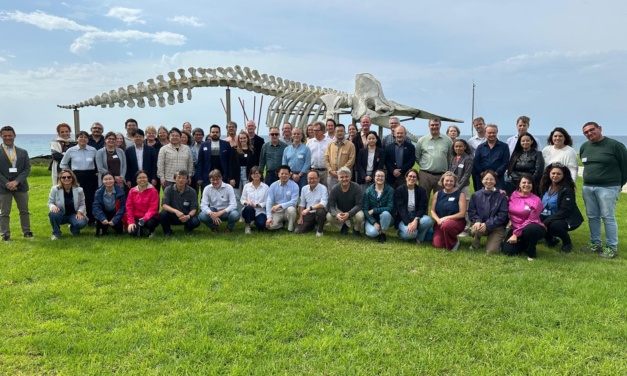
More than 50 representatives from four continents gathered in Sicily, Italy, from October 14 to 16 for the first Scientific Drilling Forum. 
Hosted by the Institute for the study of Anthropogenic impacts and Sustainability in the marine environment (IAS) of the Italian National Research Council (CNR) in Capo Granitola, with the support of the National Institute of Oceanography and Applied Geophysics (OGS), this forum marked a significant occasion for fostering international collaboration in Earth science research.
Participants included scientists, stakeholders, and funding agencies from major global programs that use scientific drilling to investigate the Earth’s history and dynamics. These programs included China’s Deep Ocean Drilling Program, the International Continental Scientific Drilling Program (ICDP), the International Ocean Drilling Programme (IODP3), and the U.S. Ocean Drilling Program.
The forum highlighted the essential role of scientific drilling in understanding Earth’s systems and addressing global environmental challenges for strengthening international cooperation and ensuring equitable access to scientific opportunities and data across different nations and institutions.
Over the three day forum, participants exchanged updates on upcoming research, identified shared scientific priorities, and discussed opportunities for joint initiatives such as expeditions, workshops, outreach initiatives and legacy asset programs. They also shared operational insights and discussed harmonized policies across programs, such as the management of core samples in scientific ocean drilling repositories.

Join the Editorial Board of the Proceedings of the International Ocean Drilling Programme

The Proceedings of the International Ocean Drilling Programme is an open-access multidisciplinary journal dedicated to publishing the scientific outcomes of IODP3 offshore and SPARC expeditions.
We are currently seeking Topic Editors to join our Editorial Board – please contact us to join our team!
The scientific outcomes generated by each IODP3 offshore and SPARC expedition are made available to the community in the Proceedings of the International Ocean Drilling Programme, an open-access journal published by Copernicus Publications (https://www.proceedings-iodp3.net).
Each expedition has its own dedicated Proceedings volume containing the following content:

Scientific Prospectuses outlining the background and scientific objectives of each expedition, providing key information to scientists considering applying to join the Expedition Science Team
Expedition Summaries (equivalent to the Preliminary Reports from the International Ocean Discovery Program phase) presenting the key operational and scientific outcomes of an expedition
Methods and Site Reports (for offshore expeditions) presenting the methodologies used during an expedition and the scientific results generated at each new site
SPARC Results (for SPARC expeditions) presenting the scientific outcomes of analyses of legacy materials and associated data, organised by research discipline
Data Reports publishing additional data and results from expedition analyses.

We are committed to ensuring that all elements of each Proceedings volume are thoroughly and externally peer-reviewed prior to publication.
To achieve this, we now need to recruit a team of Topic Editors to work with the Proceedings Chief Editors.
As a Topic Editor, you would oversee the editorial handling of components of our volumes related to expeditions that are broadly allied to your own research interests.  Your main role would be to assign manuscripts to reviewers and then manage the review process using the Copernicus Publications systems. Each volume will have two or more Topic Editors working together to cover the associated editorial duties. Topic Editors receive the full support of our Chief Editors (e.g., by helping to identify suitable reviewers).
So please contact Dr Myriam Kars (Chief Editor) in the IODP3 Science Office by emailing publications@iodp3.org if you are interested in joining our team and either:

have been involved previously in scientific ocean drilling and want to keep contributing to its success moving forwards, or
want to be become involved in scientific ocean drilling for the first time and have expertise in one or more of the themes of the 2050 Science Framework

Chief Editors:
Myriam Kars, Nobu Eguchi and Antony Morris
IODP3 Science Office

Call for applications – Topic Editors

IODP³-NSF Expedition 501 – Successful offshore operations will launch onshore research

74 days offshore, 718 cores, 871.83 meters of total core from three locations – this is the first outcome after the end of offshore operations of IODP³-NSF Expedition 501 “New England Shelf Hydrogeology”. The goal of the expedition was to take samples not only of sediment cores, but also of the water stored in sediment, both sandy aquifers and clayey aquitards beneath the ocean floor. Their existence has been known for decades but they remained virtually unexplored – until now. 
The expedition is a joint collaboration between the International Ocean Drilling Programme (IODP³) and the US National Science Foundation (NSF). For the first time scientists managed to take water and sediment samples from beneath the ocean on the New England Shelf with the intention of understanding this offshore aquifer system.
”We set out with lofty goals to understand the origin and age of this offshore freshened groundwater system through sampling of sediment and water in a difficult drilling environment consisting of sand and mud. With great teamwork among the science team, the technical staff, and the drilling crew, we managed to get great samples including through multiple groundwater pumping tests,” says Prof. Brandon Dugan, Co-Chief Scientist of the expedition. “Those tests were a critical to the Expedition and a first for scientific ocean drilling. And we did it! Now we have the samples for the science team to really dive into the data and understand the system, which will be helpful for understanding other offshore freshened groundwater systems around the world.”
Co-Chief Scientist Rebecca Robinson adds: “The pump tests were challenging and required us to adapt our processes to get the best possible samples of the groundwater. In the end we pumped nearly 50,000 liters of water from nine distinct places, in terms of location and depth below seafloor – a huge success story for something so novel. For me in particular, as a geochemist not a hydrogeologist, I am so appreciative to everyone that leant their expertise. Especially the team of hydrogeologists from the British Geological Survey were outstanding.”
Co-Chief Scientist Karen Johannesson: “Some of the groundwaters were remarkably dilute with salinities around and even below 1 psu (practical salinity unit). To put this into a context that most can understand, 1 psu is the same as 1 gram per liter of total dissolved solids, or 1.000 mg/L. Seawater averages about 35 psu. Groundwaters with total dissolved solids less than 1.000 mg/L are fit for human consumption as a drinking water resource, whereas water with around 1.000 mg/L are fit for livestock. The presence of freshened groundwater in sandy, unconsolidated Paleogene and even Cretaceous continental shelf sediments 20 to 50 miles offshore is exciting. I look forward to learning more about when these groundwaters were recharged to these sediments and what the past climate was like when these groundwaters entered these offshore aquifers.”
During the expedition, the science team rotated on and off the Liftboat Robert transported by helicopter or supply vessel. The entire science team will meet for the onshore operations at the Bremen Core Repository, at MARUM – Center for Marine Environmental Sciences at the University of Bremen (Germany) in January and February 2026 to split, sample, and analyze the sediment cores and water collected. The cores will be archived and made accessible for further scientific research for the scientific community after a one year-moratorium period. All expedition data will be open access in the IODP³ MSP data portal in PANGAEA, and resulting outcomes will be published.

International approach 
41 science team members from 13 nations (Australia, China, France, Germany, India, Italy, Japan, Netherlands, Portugal, Sweden, Switzerland, United Kingdom, USA) take part in the expedition that consists of two phases: offshore and onshore operations. Offshore Operations has taken place between May and early August 2025. 
The expedition is conducted by the European Consortium for Ocean Research Drilling (ECORD) as part of the International Ocean Drilling Programme (IODP³), funded by IODP³ and the US National Science Foundation (NSF).
More Information: 
About the expedition – https://www.ecord.org/expedition501/ 
Scientific Prospectus – https://iodp3.org/documents/expedition-501-scientific-prospectus/  
About the international research collaboration – https://iodp3.org/about/
About the European part of the program – https://www.ecord.org/ 
and Mission-Specific Platform expeditions – https://www.ecord.org/expeditions/msp/concept/  
Frequently Asked Questions – https://expedition501.wordpress.com/2025/02/19/faq1/Offshore   
Caption: 
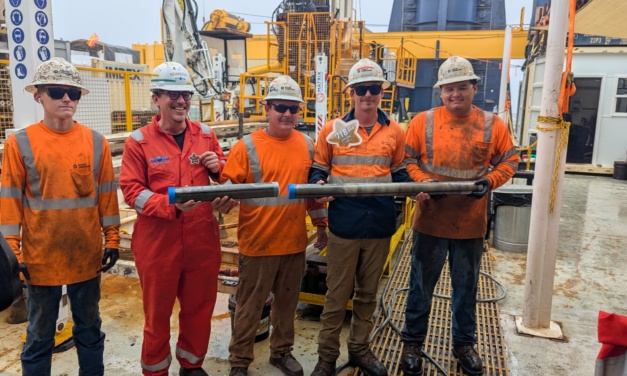
The final core from the final Hole! From left: The Boart Longyear team Chris Redding, Co-Chief scientist Brandon Dugan, Chandler Maine, Nick Boehne and Lalo Aguilar. Photo: Everest@ECORD_IODP3_NSF
The Liftboat Robert. Photo: Everest@ECORD_IODP3_NSF
Contact:
IODP³-NSF Expedition 501 Co-Chief Scientists:
Professor Brandon Dugan
Colorado School of Mines, Golden (USA)
Email: dugan@mines.edu 
Professor Karen Johannesson
University of Massachusetts, Boston (USA)
Email: Karen.Johannesson@umb.edu
Professor Rebecca Robinson
Graduate School of Oceanography, University of Rhode Island (USA)
Email: rebecca_r@uri.edu 
IODP³-NSF Expedition 501 Operations: 
Dave McInroy
ECORD Science Operator
British Geological Survey (UK)
Email: dbm@bgs.ac.uk
ECORD Outreach: 
Ulrike Prange
ECORD Science Operator – Outreach and Media Relations
MARUM – Center for Marine Environmental Sciences
University of Bremen (Germany)
Email: uprange@marum.de

IODP3 Mission Statement
To advance scientific understanding of Earth’s processes and history by exploring and monitoring the subseafloor, unlocking insights into climate change, geohazards, the deep biosphere and Earth system evolution through international collaboration, cutting-edge technology, and open data sharing.
The International Ocean Drilling Programme (IODP³) is committed to fostering global scientific cooperation, building capacity across nations, and promoting responsible stewardship of our planet’s oceanic resources for the benefit of future generations.

UNDERSTANDING THE OCEAN BELOW THE SEAFLOOR

The Keynotes of Our Event are available here

UNDERSTANDING THE OCEAN BELOW THE SEAFLOOR
Scientific ocean drilling: a global infrastructure linking the past and future of Planet Earth
June 3, 2025 , Institut de la Mer de Villefranche (IMEV), France

IODP³-NSF Expedition 501 “New England Shelf Hydrogeology”

Research project investigates freshened water under the ocean floor
Start of an international expedition off the coast of New England
Freshwater under the Ocean – in the 1960’s scientists were quite surprised when they looked at their data: it clearly showed that there was fresh or freshened water under the ocean floor. How did it get there? How long has it been there? Scientists have been trying to find answers to these questions since their intriguing discovery. Starting in May, an international team of scientists has embarked on an expedition to take a closer look at, and take samples, of this freshened water stored beneath the ocean floor. Prof Karen Johannesson of University of Massachusetts Boston and Prof Brandon Dugan of Colorado School of Mines are the Co-Chief Scientists of this international expedition. Samples will be collected using the Liftboat Robert, which departed from the port of Bridgeport on May 19.
Seventy percent of the Earth’s surface is covered with water, but water also flows beneath its surface. Most coastal communities rely on traditional onshore aquifers for freshwater, however, in many locations worldwide onshore aquifers may have an offshore component where freshened water exists under the ocean floor. Even though the existence of these waters has been known for decades they remain virtually unexplored. This will change through the ground-breaking research to be completed during this expedition, which is a collaboration between the International Ocean Drilling Programme (IODP³) and the US National Science Foundation (NSF). For the first time scientists on IODP³-NSF Expedition 501 “New England Shelf Hydrogeology” will take water and sediment samples from beneath the ocean on the New England Shelf with the intention of understanding this offshore aquifer system.
Aim: Validate hypotheses about water origin
The key priority for researchers is to gain more knowledge about the origin of freshened groundwater in offshore aquifers so that they can confirm or dismiss the existing hypotheses. For example, current hypotheses are that the water could have charged the aquifers at a time when sea-level was 100 meters lower than it is today, or perhaps it was generated under an ice sheet or pro-glacial lake during a glacial period such as existed approximately 450,000 and approximately 20,000 years ago.
Hydrogeologist Brandon Dugan: “We have anecdotal evidence of offshore freshened groundwater from samples and marine geophysical surveys. We have used this evidence to develop hypotheses on timing and mechanism of emplacement. It is exciting to use established scientific ocean drilling approaches with modern data analyses to provide direct tests of our hypotheses. Overall, this work offshore New England will help us better understand offshore freshened groundwater around the world.”
Environmental Geochemist Karen Johannesson: “To date, we know very little about the dynamics of these shoreline-crossing groundwater systems and the age of the water in these systems, and even less about their influence on cycling of nutrients and trace elements and their isotopes.”
The expedition begins in May. A special platform, the liftboat ‘L/B Robert’ equipped with a small drilling rig, will be used to access the sediments below the ocean floor at up to three locations on the New England Shelf offshore from the coast of Massachusetts, USA. These locations are in relatively shallow water and were identified through numerous preliminary geoscientific investigations. Sediment cores and water samples will be taken down to a maximum depth of 550 meters below the ocean floor and will be examined by researchers from various disciplines drawn from across the international scientific community.
High societal relevance: to better understand aquifers around the world
The team believes that the data acquired will help to better understand the processes that lead to the emplacement of freshwater lenses in offshore coastal plain sediments and why this freshened water is present. The findings will be relevant for the hydrogeology of the New England Shelf and for multiple similar settings elsewhere around the world.
The research is essential for a better understanding of the biogeochemical and elemental cycles in the continental shelf environment and will support a focus on the protection and sustainable management of offshore freshwater systems.
The expedition aims to find answers to the following questions:

How old is the freshened groundwater, and when was it emplaced?
How much freshwater is there?
How does the freshwater interact with seawater?
What microbial communities are involved?
What sources of carbon do microbes use?
What is the general cycling of nutrients and energy in the shelf sediments?
How might these freshwaters influence nutrient, carbon, and metal concentrations in seawater?

International approach
41 science team members from 13 nations (Australia, China, France, Germany, India, Italy, Japan, Netherlands, Portugal, Sweden, Switzerland, United Kingdom, USA) take part in the expedition that consists of two phases: offshore and onshore operations. Offshore Operations will take place between May and early August 2025. The entire science team will meet for the onshore work at the Bremen Core Repository, at MARUM – Center for Marine Environmental Sciences at the University of Bremen (Germany) in January 2026 to split, sample, and analyze the sediment cores and interpret the data collected The cores will be archived and made accessible for further scientific research for the scientific community after a one year-moratorium period following an onshore operations phase of the expedition. All expedition data will be open access and resulting outcomes published.
The expedition is conducted by the European Consortium for Ocean Research Drilling (ECORD) as part of the International Ocean Drilling Programme (IODP³), funded by IODP³ and the National Science Foundation (NSF). IODP³ is a publicly-funded international marine research program supported by 16 countries, which explores Earth’s history and dynamics recorded in seafloor sediments and rocks, and monitors sub-seafloor environments. Through multiple platforms – a feature unique to IODP³ – scientists sample the deep biosphere and sub-seafloor ocean, environmental change, processes and effects, and solid Earth cycles and dynamics.
More Information:
About the expedition – https://www.ecord.org/expedition501/
Scientific Prospectus – https://iodp3.org/documents/expedition-501-scientific-prospectus/
About the international research collaboration – https://iodp3.org/about/
About the European part of the program – https://www.ecord.org/  and Mission-Specific Platform expeditions – https://www.ecord.org/expeditions/msp/concept/
Frequently Asked Questions – https://expedition501.wordpress.com/2025/02/19/faq1/Offshore
Caption:
Science and ECORD Science Operator Team and of the first rotation onboard liftboat L/B Robert. It will be home for the science team until August. Photo: Everest@ECORD_IODP3_NSF
Contact:
IODP³-NSF Expedition 501 Co-Chief Scientists:
Professor Brandon Dugan
Colorado School of Mines, Golden, USA
Email: dugan@mines.edu
Professor Karen Johannesson
University of Massachusetts, Boston, USA
Email: Karen.Johannesson@umb.edu
IODP³-NSF Expedition 501 Operations:
Dave McInroy
ECORD Science Operator
British Geological Survey (UK)
Email: dbm@bgs.ac.uk
ECORD Outreach:
Ulrike Prange
ECORD Science Operator – Outreach and Media Relations
MARUM – Center for Marine Environmental Sciences
University of Bremen (Germany)
Email: uprange@marum.de
Phone: +49 421 218-65540
Follow the expedition via Bluesky (@ecord.bsky.social ), X/Twitter (@ECORD_IODP), Instagram (@ECORD_IODP), Youtube (ECORD IODP) or Mastodon (@ECORD@mastodon.world), or the offshore expedition logbook (https://expedition501.wordpress.com).
 

Loading
Privacy Overview

This website uses cookies so that we can provide you with the best user experience possible. Cookie information is stored in your browser and performs functions such as recognising you when you return to our website and helping our team to understand which sections of the website you find most interesting and useful.

By clicking on "Accept", you accept the use of cookies from this site and our privacy statement.

You can adjust all of your cookie settings by navigating the tabs on the left hand side.